- Thriving Guide
- Posts
- The Truth About Pinhole Glasses and Vision Improvement
The Truth About Pinhole Glasses and Vision Improvement
These unusual lenses might sharpen your sight temporarily but are they worth using outside the eye doctor’s office?

Audrey Sawyer
January 28, 2026
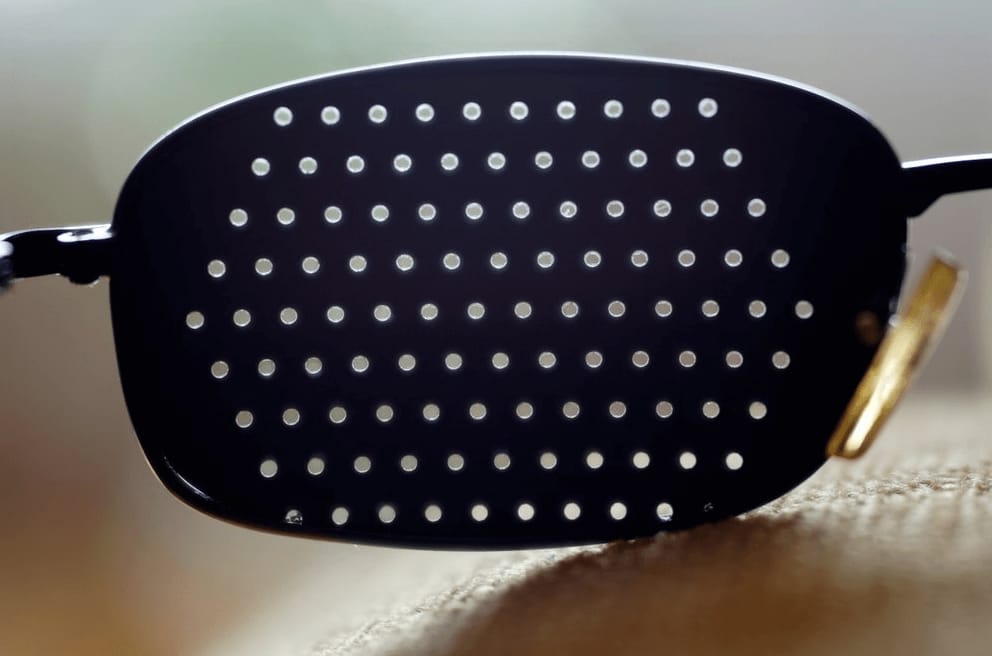
If you've ever squinted to bring something into focus, you’ve experienced the basic principle behind pinhole glasses. These unusual-looking glasses, made with opaque lenses peppered with tiny holes, are gaining attention online for their supposed ability to improve vision. But do they really work and are they worth a try?
Here’s what the science and eye health experts have to say.
What Are Pinhole Glasses?
Pinhole glasses also called stenopeic glasses have lenses made from a dark plastic sheet with multiple tiny holes. The idea is simple: by allowing only narrow beams of light to enter the eye, they reduce the scattering of light rays. This limits distortion and can create a sharper image on the retina.
In effect, they mimic what happens when you squint, narrowing the path of light to focus more directly. That’s why people with vision issues often experience momentary clarity when using pinhole glasses.
How Pinhole Glasses Work
The purpose of these glasses is to block peripheral light rays that may distort your vision and allow only straight light rays through the holes. This makes the image entering your eye more focused temporarily improving visual sharpness.
Here’s what that might look like:
If you have myopia (nearsightedness) or astigmatism, pinhole glasses may help you see more clearly in the short term.
If your vision is blurry due to refractive errors, pinhole glasses can simulate what corrective lenses might achieve.
Eye doctors use a pinhole occluder during exams to quickly determine whether blurred vision is due to a structural issue or simply an uncorrected prescription.
A Common Diagnostic Tool Not a Long-Term Solution
Pinhole glasses are mainly used by eye care providers during quick vision screenings. For example, if a patient comes in with an eye infection and blurry vision, an optometrist may use a pinhole test. If the patient sees significantly better through the pinholes, it suggests the vision issue isn’t due to the infection, but likely an uncorrected refractive error.
This test helps differentiate between temporary conditions and vision problems that require corrective lenses. In other words, pinhole glasses are a useful tool but not a treatment.
When Pinhole Glasses Might Be Useful
For most people, pinhole glasses are not practical for everyday use. They can significantly limit peripheral vision and reduce brightness, making them unsafe for driving or walking in unfamiliar areas.
That said, there are a few situations where they may have a place:
In emergencies: If you have a high prescription and lose or break your regular glasses, pinhole glasses can serve as a temporary backup.
For rare eye conditions: Individuals with aniridia, a condition involving partial or complete absence of the iris, may find relief from glare and improved focus using pinhole glasses. Because their eyes can't regulate incoming light, the limited light from the pinholes can help improve clarity.
For brief, at-home testing: If you’re curious whether blurry vision might be due to a refractive error, looking through a homemade pinhole (like your fingers shaped into a small circle) can offer insight. However, it’s not a replacement for a professional eye exam.
Do They Improve Vision Long-Term?
There’s no evidence that pinhole glasses permanently improve vision or can correct eye conditions like nearsightedness, farsightedness, or astigmatism. While they can sharpen your vision momentarily by filtering light, they don’t treat the underlying issues.
A 2020 review published in Clinical and Experimental Optometry emphasized that pinhole glasses do not stimulate or retrain the eyes in any way, and claims that they can “cure” vision problems are unsupported.
Bottom Line: Worth a Try?
If you’re curious, it’s safe to experiment with pinhole glasses at home, especially if you find yourself without your regular glasses. But for long-term vision care, nothing replaces proper corrective lenses and regular eye exams.
Key Takeaways:
Pinhole glasses can momentarily improve focus for people with certain vision issues.
They are a diagnostic tool, not a treatment or cure.
Not recommended for regular use due to limited visibility and reduced brightness.
May be helpful in rare cases or as an emergency backup.
Your eyes are complex, and while a pair of perforated plastic lenses might offer temporary clarity, lasting vision health comes from personalized care.
If this article helped you, consider sharing it or subscribing to our newsletter for more science-backed wellness tips.